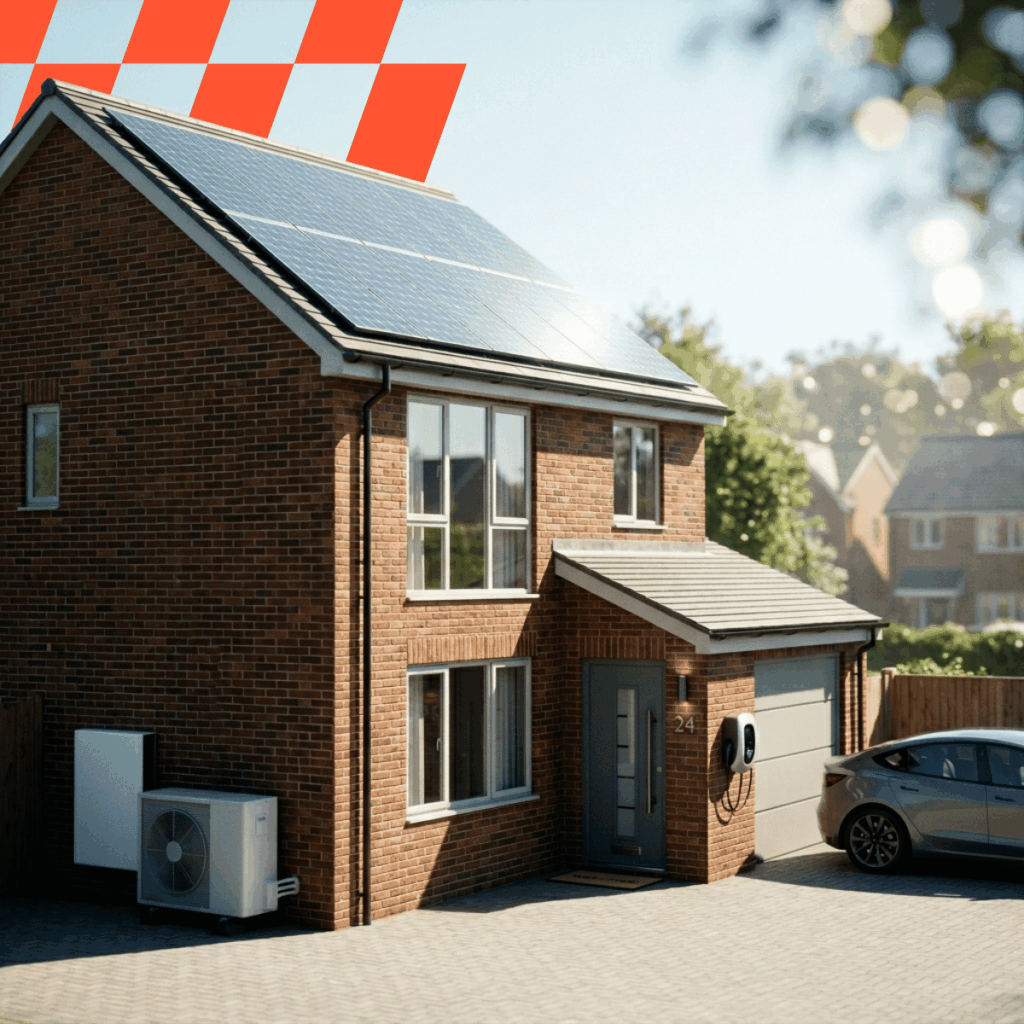
The Future Homes Standard has been published. From 2028, every new home built in England must include on-site renewable generation, low-carbon heating, and meet significantly tighter fabric efficiency standards.
This raises an uncomfortable question for developers: if everyone must comply, how do you compete?
Compliance is the floor. Differentiation is everything above it.
The commoditisation trap
When a regulatory requirement applies universally, the temptation is to treat it as a box-ticking exercise. Install the minimum solar, fit the cheapest heat pump, hit the compliance score and move on. Many developers will do exactly this.
The problem is that buyers and planners are getting more sophisticated. They can tell the difference between a home designed for real-world energy performance and one that scraped through compliance. In a market where every home must meet the FHS, the developers who went further will stand out.
The question is not whether to differentiate, it’s where.
Five ways to differentiate above the FHS baseline
1. Size the solar system for real energy demand — not minimum compliance
The FHS sets a floor, not a ceiling. Under the published standard, on-site renewable electricity generation is a functional requirement of Building Regulations, not just part of the notional building specification. You cannot trade it away with better insulation or a more efficient heat pump. The sizing formula is straightforward: 40% of the home’s ground floor area, divided by 4.5, gives the required system size in kWp. For a typical 3-bed semi, that is roughly 3.5 to 4 kWp.
But the compliance model is based on regulated energy only: heating, hot water, ventilation and lighting. It does not capture the full energy demand of a modern all-electric home, which includes EV charging, appliances, and everything else you plug into your sockets.
A home with a larger, well-designed solar system will generate meaningfully more value for the homebuyer — lower bills, greater energy independence, and resilience against future electricity price rises. This is a credible, quantifiable point of difference.
2. Add battery storage
Solar without storage is half a solution. A battery allows homeowners to use the energy thats generated during the day in the evening when demand peaks, rather than exporting it to the grid at a low rate and buying it back at a higher one.
For all-electric homes with heat pumps and EV chargers, the economics of battery storage are compelling. When the Home Energy Model (HEM) replaces SAP as the compliance methodology, its 30-minute interval modelling will directly reward self-consumption, making battery storage even more valuable in compliance terms. Very few minimum-FHS homes will include it. For developers who do include it, it becomes a tangible selling point.
3. Compete on system quality and warranty
Not all solar panels, inverters or heat pumps are equal. A panel installed by the lowest-cost subcontractor with a 10-year warranty is not the same product as a premium system with a 25-year performance guarantee and active monitoring.
Homebuyers increasingly understand this — particularly repeat buyers and those who have lived in energy-inefficient homes. Specifying quality components and communicating that clearly in your sales process is a differentiator that costs relatively little in proportional terms.
4. Give homeowners visibility of their energy use
The best-performing energy systems are ones homeowners actually understand and engage with. Smart monitoring, an app that shows generation, consumption, battery state and grid import in real time, transforms energy from an abstract utility bill into something tangible and engaging.
Developers who provide this as standard are building a product experience, not just a building. That experience lives with the homeowner for decades and drives word-of-mouth recommendation.
5. Remove the ownership friction entirely
For many homebuyers, the residual concern about solar and battery systems is not the technology, it’s the responsibility. What happens when something breaks? Who maintains it? What does it cost to replace?
A subscription or lease model, where the system is funded, specified and managed by a third party at no upfront cost, removes all of that friction. The homebuyer gets the benefits of the technology without the liability of ownership. For developers, it removes capital cost and operational complexity from the development entirely.
This is the model Gryd was built to deliver.
The window is closing
Today, FHS-ready homes are exceptional. They stand out on planning applications, in sales suites and in press coverage. By March 2028, when the transition period ends, they will be the norm.
The developers who use the next 12 months to build genuine expertise in design, supply chain, buyer communication and energy system quality will enter the post-FHS era with a head start that is very difficult for late movers to catch up with.
Don’t let compliance become your ceiling. Use it as a launchpad.