Summary
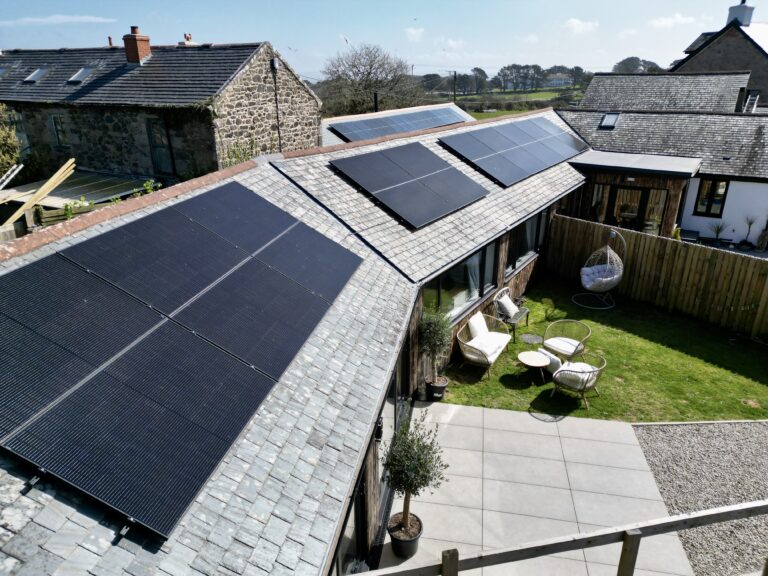
BK Developments partnered with Gryd on their barn conversion project in St. Ives, Cornwall — three all-electric Build-to-Rent homes with Air Source Heat Pumps. Rising build costs had forced the developer to abandon solar entirely. Gryd stepped in with a fully-funded solar and battery system provided at zero cost, upgrading the properties from no renewable energy to 49% grid independence.
The result: EPC A-rated homes, £158.87 in verified first-year tenant savings (14.1%), ~0.81 tonnes of CO₂ avoided annually, and a clear demonstration of what can be achievedwith innovative solutions to renewables challenges.
Key Details
Developer: BK Developments
Project: Barn conversion — 3 residential units
Location: St. Ives, Cornwall
Type: Build-to-Rent (BTR)
Heating: All-electric with ASHP
System installed: 10 solar panels and 5.4 kWh battery
Data period: April 2025 – March 2026 (12 months, monitored)
Key Outcomes
- Zero additional cost to include solar and battery
- EPC uplift from B to A
- 14.1% tenant bill saving (£158.87/year)
- 49% of consumption met by on-site solar
- 3,919 kWh of clean energy generated
- ~0.81 tonnes of CO₂ avoided per year
- Gryd’s proof of concept validated with real data
The Developer
BK Developments is a property developer delivering high-quality residential homes in the South West of England. For the St. Ives project, they acquired a traditional barn with planning permission to convert it into three modern homes. They chose to run it as a Build-to-Rent (BTR) scheme, retaining the freehold and letting the properties to tenants on long-term rental agreements.
The BTR model meant that running costs mattered. Tenants would be living in these homes day-to-day, paying the bills, and their experience would directly affect tenant experience, retention and rental yields. Getting the energy specification right was a commercial priority, not just a sustainability aspiration.
Lorem ipsum dolor sit amet, consectetur adipiscing elit. Ut elit tellus, luctus nec ullamcorper mattis, pulvinar dapibus leo.
The project delivered three all-electric residential properties in St. Ives, Cornwall — each fitted with Air Source Heat Pumps (ASHPs) for heating and hot water, eliminating gas dependency entirely. This aligned with current building regulations and the UK’s push toward net zero.
However, with no gas alternative, electricity was the single largest running cost for tenants. Every kilowatt-hour of heating, hot water, cooking, and appliance use would come from the grid at the prevailing tariff rate — making the energy specification critical to the affordability of the homes.
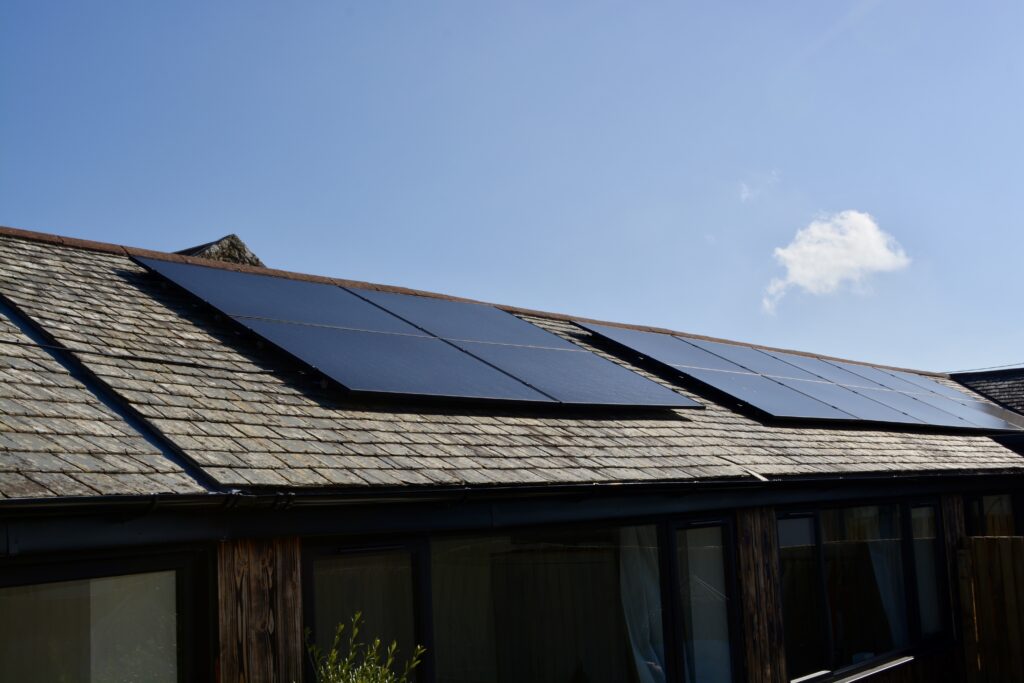
BK Developments recognised early on that adding solar panels would make the properties more attractive to prospective tenants and differentiate the scheme in a competitive Cornish rental market.
The Challenge
As the project progressed, rising build costs forced the developer to abandon their solar plans. The additional capital expenditure for panels, inverters, and battery storage across three units simply couldn’t be justified within the project budget.
This left the developer with a dilemma:
- Without solar, tenants in all-electric ASHP homes would face the full cost of the Standard Variable Tariff for every kilowatt-hour consumed. With no gas alternative, winter bills would be particularly high — ASHP demand peaks in the coldest months when electricity is needed most.
- Adding solar would reduce tenant bills and improve the property’s appeal —but the cost had ruled it out.
“We always wanted solar on these homes. They’re all-electric with heat pumps, so we knew the energy bills would be the first thing tenants looked at. But when build costs started climbing, we had to make hard choices, solar was one of the things that fell off the spec. It was frustrating, because we could see the value it would add, but the numbers just didn’t work.”
— Ben, Director, BK Developments
The Solution
How Gryd got involved
BK Developments discovered Gryd and found a model that resolved the tension entirely. Gryd could deliver a fully-funded solar and battery system on each property, at zero capital cost to the developer.
This was Gryd’s very first project — a proof of concept that would validate the model with real-world performance data from a live scheme.
The Gryd model for BTR
The BTR structure created a clean commercial arrangement:
- Gryd funds the solar and battery system on each property — no cost to BKDevelopments.
- The developer subscribes at £50/month for each unit, recovered from the tenant as part of their rental charge.
- Tenants benefit from solar generation that offsets their consumption, plus, as there is a battery in the system they can take advantage of a Time of Use Tariff, charging it overnight at a cost significantly below the SVT.
- The property improves — the SAP scores increase and each homes EPC rating moves from B to A, enhancing long-term asset value.
12-Month Performance
The following results are based on actual monitored data from the Gryd system at one of the three units over the 12-month period April 2025 to March 2026.
Energy performance
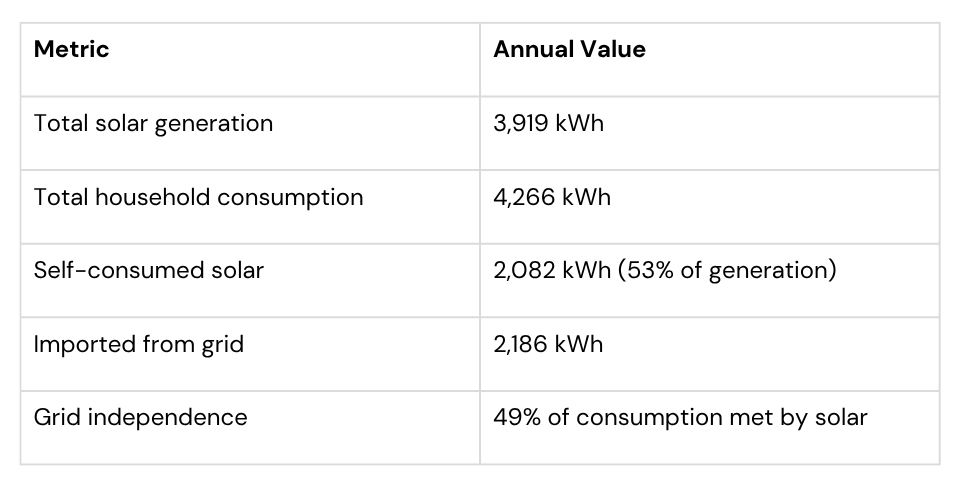
For half the year, the property generated more electricity than it consumed — a remarkable outcome for a UK property, particularly with only 10 panels installed. Even across the full year, nearly half of all consumption was met directly by solar and battery storage.
Seasonal Profile
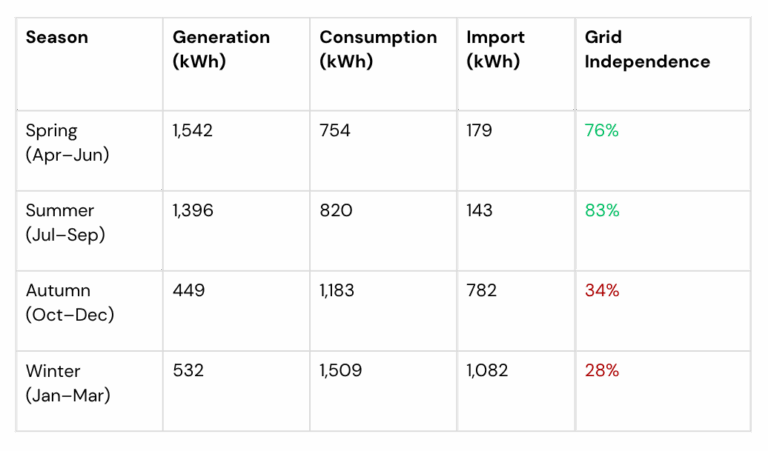
During spring and summer, the system covered 76–83% of all consumption from solar — dramatically reducing grid reliance. Even in winter, the system still offset over a quarter of demand.
Financial impact: tenant bill savings
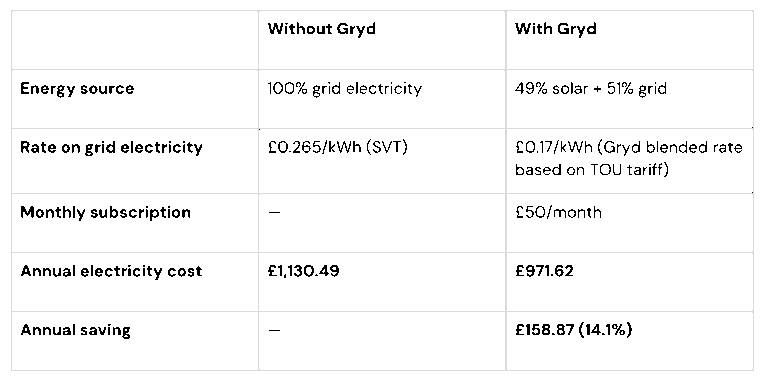
This is where the Gryd model delivers tangible value.
Monthly Savings Breakdown
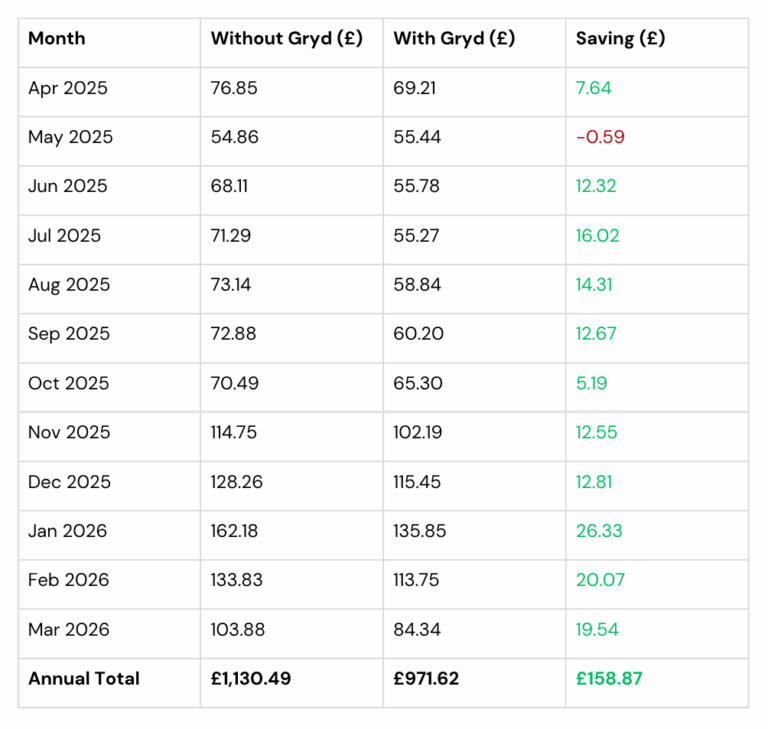
Figures exclude daily standing charge, applicable with or without Gryd.
Key takeaways from the data:
11 out of 12 months delivered a positive saving. The only exception was May — the tenant was away on holiday for two weeks, reducing consumption to just 207 kWh. With the SVT bill at only £54.86, it fell marginally below the Gryd cost. The difference: just 59p. Under normal occupancy, May would almost certainly have delivered a positive saving.
Even in Winter Gryd delivered. January delivered the largest monthly saving (£26.33). Despite minimal solar generation, the reduced per-kWh rate from the TOU tariff, made accessible as a result of the battery, meant significant savings with overnight charging to power the ASHP throughout the day.
The £50 subscription pays for itself every month where consumption exceeds approximately 189 kWh — which was every month except May.
Energy price sensitivity
The saving grows as energy prices rise. At crisis-era SVT levels, the system would save nearly £356/year:
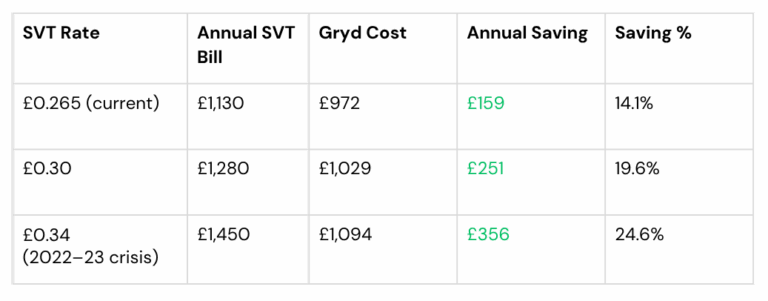
Every £0.01/kWh increase in the SVT, approximately £26 is added to the annual saving. The Gryd subscription offers a natural hedge against energy market volatility.
The Impact
For the developer
- Zero additional build cost for solar and battery — abandoned due to rising construction costs; Gryd restored it at no expense EPC A ratings across all three properties (up from B)
- More attractive rental proposition — lower running costs and visible ESG credentials
- Regulatory future-proofing — an A rating provides substantial headroom above upcoming MEES requirements
- Higher asset value — EPC A correlates with stronger property valuations and rental yields
For homeowners
- £158.87 saved per year (14.1%) — verified from 12 months of monitored data
- 49% grid independence — nearly half of all electricity consumed came from on-site solar
- 2,082 kWh of clean energy consumed on-site, avoiding approximately 0.81 tonnes of CO₂ per year
- Protection from energy price rises and market volatility — tenants are partially shielded from future energy price increases
What Sets Gryd Apart
Gryd funds the hardware. The developer pays nothing. Solar panels, batteries, inverters, and smart monitoring — all provided, installed, and maintained through Gryd’s SPV-funded model. Developers get best-in-class energy systems on every home without impacting build budgets.
This project demonstrates what makes Gryd different:
- Zero capex for the developer — no impact on build cost or project margin
- Purpose-built for BTR — the subscription model aligns perfectly with rental properties, transferring seamlessly between tenants
- Real-world proof — 12 months of monitored data validates the model with verified savings, not projections
- Performance despite constraints — even with only 10 panels (vs a typical 14–16), the system delivered 49% grid independence and 14% bill savings
- EPC uplift — moving from B to A adds tangible value to the asset and future-proofs against regulation
- Energy price hedge — the fixed Gryd rate protects tenants from SVT volatility, with savings growing as prices rise
“Every developer we speak to faces the same tension. They want to build high performance homes, but the economics won’t stretch. This project proved that tension doesn’t have to exist. We now have twelve months of real-world evidence that our model delivers for every stakeholder, and that gives developers the confidence that greener, more affordable homes aren’t a trade-off. They’re the new standard.”
— Mohamed Gaafar, Co-Founder & CEO, Gryd