Social housing is under intense pressure. Landlords are being asked to decarbonise ageing stock, tackle fuel poverty, improve tenant wellbeing and meet increasingly rigorous ESG standards – all while operating in one of the most constrained funding environments the sector has ever faced.
For local authorities and housing associations delivering affordable developments, the expectations on new schemes are rising just as build costs, regulation and financing requirements tighten.
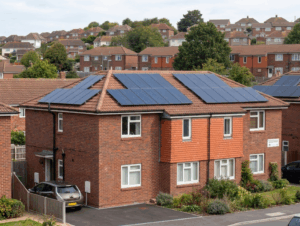
Solar is widely recognised as part of the solution. It cuts carbon, lowers energy costs and limits exposure to energy market volatility. Yet most social housing still does not have solar. Research undertaken by Gryd found that just 5.5% of council-owned homes benefit from rooftop solar. Where it does, systems are typically sized to minimum requirements, with limited capacity and almost no battery storage. The barrier is simple: installation of properly-sized systems requires significant upfront capital that many landlords cannot spare.
For developers, this creates a contradiction. Solar strengthens affordability and ESG performance on paper, but is frequently stripped out of schemes due to cost. The challenge is no longer whether solar belongs in social housing, but how it can be delivered without increasing development cost or landlord balance-sheet pressure.
Why solar has never been more important for social housing
Fuel poverty is concentrated in the social rented sector, where households are more likely to be on fixed or low incomes and less able to absorb sudden rises in living costs. When the energy crisis drove prices to record levels, social housing tenants were exposed first and hardest.
Solar changes that exposure. By generating electricity on site, part of a tenant’s energy use is shielded from external price shocks, reducing dependence on volatile wholesale markets and creating a stabilising effect.
The impact goes beyond simple bill reduction. For households living close to the financial edge, volatility is often more damaging than high absolute costs that could be planned for. Removing uncertainty from monthly energy spend gives tenants greater control over their finances – enabling them to budget, reduce reliance on short-term credit and lower the risk of arrears building up across other essentials, like rent.
For landlords, that stability translates directly into lower default risk. When energy bills stop spiking unpredictably, tenants are far more likely to maintain consistent rental payments. Solar therefore functions not only as a decarbonisation tool for social housing but as a quiet stabiliser of rental income.
The ESG and funding imperative
Environmental, Social and Governance performance is now a core driver of funding, planning and investment decisions across the housing sector. Social landlords are judged on measurable progress against decarbonisation, affordability and tenant outcomes.
Solar supports all three. It delivers immediate building-level emissions reductions, directly improves energy affordability and signals alignment with national decarbonisation policy.
It also supports eligibility for key public funding streams, particularly the Social Housing Decarbonisation Fund and ECO4. Social landlords may also be able to benefit from public funding for solar through the Warm Homes Fund, though scheme design and eligibility details are still to be announced.
For housebuilders operating in the affordable sector, this matters. Developments that strengthen landlords’ ESG performance and funding eligibility are more attractive partners, particularly as housing associations become increasingly selective about pipeline projects.
Why Gryd Is the right model for affordable housing
The primary barrier to scaling solar in social housing has always been capital. Either developers absorb the cost at construction stage, or landlords fund installations from already constrained budgets. In practice, this has meant solar is often deprioritised in favour of immediate statutory requirements.
Gryd removes that barrier by eliminating the need for upfront capital altogether. Solar and battery storage is delivered through a leasing model that allows it to be installed at construction stage without adding to the developer’s build cost or the landlord’s balance sheet. Tenants benefit from lower energy bills and on-site generation from day one, while landlords gain ESG and decarbonisation benefits without diverting capital from safety works or core asset management.
Gryd’s model ensures the households who benefit from solar are not just those who can afford a premium, but those who most need protection from energy market volatility.
Gryd also monitors, manages and maintains the energy systems, removing the burden of ownership from housing associations.
From energy savings to financial stability
The conversation around solar often centres on projected bill savings in pounds and pence. In the context of social housing, that framing is too narrow. The deeper impact lies in what stable energy costs unlock for households already under financial strain.
Solar becomes part of a wider financial story that links energy, housing security and long-term household stability.
For housebuilders, this creates an opportunity to rethink what genuine long-term value looks like in affordable housing. Solar is one of the few technologies that delivers simultaneous benefits across carbon reduction, tenant affordability and rental income stability. With Gryd, it can now be delivered without increasing build costs or diverting landlord capital.
To discuss how Gryd can be integrated into your next affordable or mixed-tenure development, speak to our team.