Home Solar is Booming – But Who Pays?
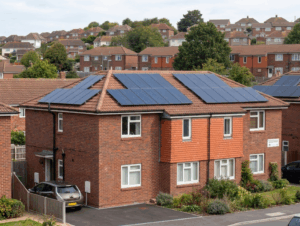
Rooftop solar is now the most in-demand home energy upgrade in the UK — and for good reason. It cuts bills, improves EPC ratings, and reduces carbon emissions. But despite rising demand, the high upfront costs of solar hardware mean many homeowners still can’t afford solar ownership.
Recent data shows that 69% of homebuyers want solar, yet 85% can’t afford the upfront cost or wait the 10+ years typically required to recover the investment through energy savings. And with 60% of first-time buyers moving within five years, traditional solar ownership models simply don’t stack up for many households.
For UK housebuilders, it’s another pressure point – especially as the Future Homes Standard will essentially make solar mandatory for all new homes from 2027. The question is: how do you deliver solar that’s future-ready, affordable, and simple to install?
In this guide, we provide a solar providers comparison for housebuilders and homeowners, looking at three leading models – ours at Gryd, Zero Bills by Octopus, and SNRG SmartGrid. – to help both builders and buyers understand the benefits and value behind each model.
Understanding the benefits and value behind each model can help you to choose the best solar solution for your needs.
Understanding Key Solar Industry Terms
Before comparing solar providers, it’s helpful to understand a few common terms used across the industry.
- PPA (Power Purchase Agreement): A contract where a homeowner agrees to purchase electricity generated by a solar system installed on their property, typically at a fixed rate.
- Solar Lease: An arrangement where a homeowner pays a fixed monthly fee to use a solar system installed and maintained by a third party.
- EPC (Energy Performance Certificate): A document that rates the energy efficiency of a property, influencing its market value and compliance with building regulations.
- FiT (Feed-in Tariff): A now-closed UK government scheme that paid homeowners for renewable electricity generated on their homes.
Provider Comparison
Below is a comparison of three different approaches to rooftop solar for new-build homes in the UK.
| Feature | Gryd | Octopus Zero Bills | SNRG |
| Cost to Developer | £0 | £15,000+ | £0 |
| Cost to Homeowner | £0 | System cost added to sale price | £0 |
| Ownership Model | Subscription-based; Gryd owns and maintains the system | Homeowner owns and maintains the system to certain standard to keep Zero Bills eligibility | SNRG owns and operates community energy systems with private metering for homes |
| Energy Pricing | Fixed subscription fee (e.g., ~£70/month for an average fully electric 3-bed home) | £0 with a fair usage policy and exclusion of EV charging (paid for on a separate tariff) | Operates as a PPA with a discounted unit rate of electricity compared to the market (typically 15%) |
| Energy Provider / Tariff Restrictions | Free to choose any provider and tariff | Must be on Octopus Zero Bills tariff | Must be on SNRG PPA tariff |
| Maintenance & Insurance | Included for 25 years | Homeowner’s responsibility | Included; SNRG manages maintenance and operations |
| System Sizing | Optimally sized per home | Maximised specification | Site-wide private network system design |
| EV Charging | Included | Not included | Included |
| Flexibility Benefit | Yes | No | No |
| Developer Involvement | Low – Deployment via your existing supply chain or a Gryd trusted partner. | High – developer must coordinate and fund spec-compliant installs | Medium – developer partners with SNRG during planning, SNRG handles funding and ops |
| Homeowner Payback | 0 years | 10+ years | 0 years |
| Regulatory Demand | Low | Medium | High |
| Home Acceptance Rate | High – almost every home | Medium – must meet Octopus’s requirements | Low – minimum site scale of 50 homes |
| Ease to Exit | Easy – exit any time with lease buyout | Easy – switch supplier | Hard – removal of private meter and installation of traditional meter at homeowner expense. |
Key Considerations With Each Provider
- Zero Bills (Octopus Energy): Octopus Zero Bills has gained attention for its promise to eliminate household energy bills for at least five years for qualifying homes. The model combines solar panels, battery storage, and a heat pump to enable homes to generate most of their energy on-site.
However, these systems typically cost £15,000–£20,000 per home. Developers must fund this infrastructure upfront, which increases development costs and ultimately raises property sale prices. In effect, homeowners may be prepaying years of future energy costs through a higher purchase price.
This model may be best suited for premium developments where buyers are willing to pay a “green premium,” but it introduces financial risk for developers if those higher sale prices cannot be achieved.
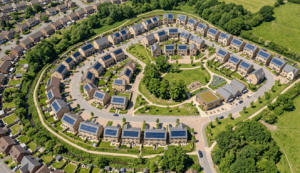
- SNRG: SNRG uses a different approach, building site-wide private microgrids with centralised generation and storage – a clever but capital-heavy solution that demands deep planning involvement, high regulatory sign-off, and significant coordination with DNOs (Distribution Network Operators).
Because of the complexity involved, this model is typically best suited to large-scale developments. It may be less flexible for smaller projects or individual homeowners seeking greater control over their energy provider.
Where Gryd’s Solar Subscription Model Stands Out
Gryd offers a subscription-based solar solution for new homes in the UK designed to remove barriers for both homeowners and developers:
- Zero-cost solar hardware for both parties
- Right-sized systems tailored to each individual home
- Can be included up to shell completion, streamlining build schedules
- Full-service model with maintenance, monitoring, and support included
- Battery storage included as standard – and no limitations on energy use including for EV charging
Gryd’s subscription model eliminates upfront costs and includes comprehensive maintenance and insurance for the 25 life of the solar and battery storage system.
For homeowners, the model means no debt, no maintenance, and immediate energy savings. For developers, there’s no capital expenditure, minimal engagement, and no added sales risk. It’s a clean, compliant, and future-proof solution.
Choosing the Right Solar Provider
By understanding the differences among providers and industry terms, homeowners and housebuilders can make informed decisions that align with their needs.
If you’re exploring solar options and want a provider that makes the process simple, affordable, and scalable, Gryd is ready to help. Whether you’re building new homes or looking to enhance an existing development, our subscription-based model takes the hassle out of solar – with no upfront costs, no maintenance, and maximum impact.
Get in touch with Gryd today to discuss how our solution compares and find out if it’s the right fit for your development.